

Velut Luna
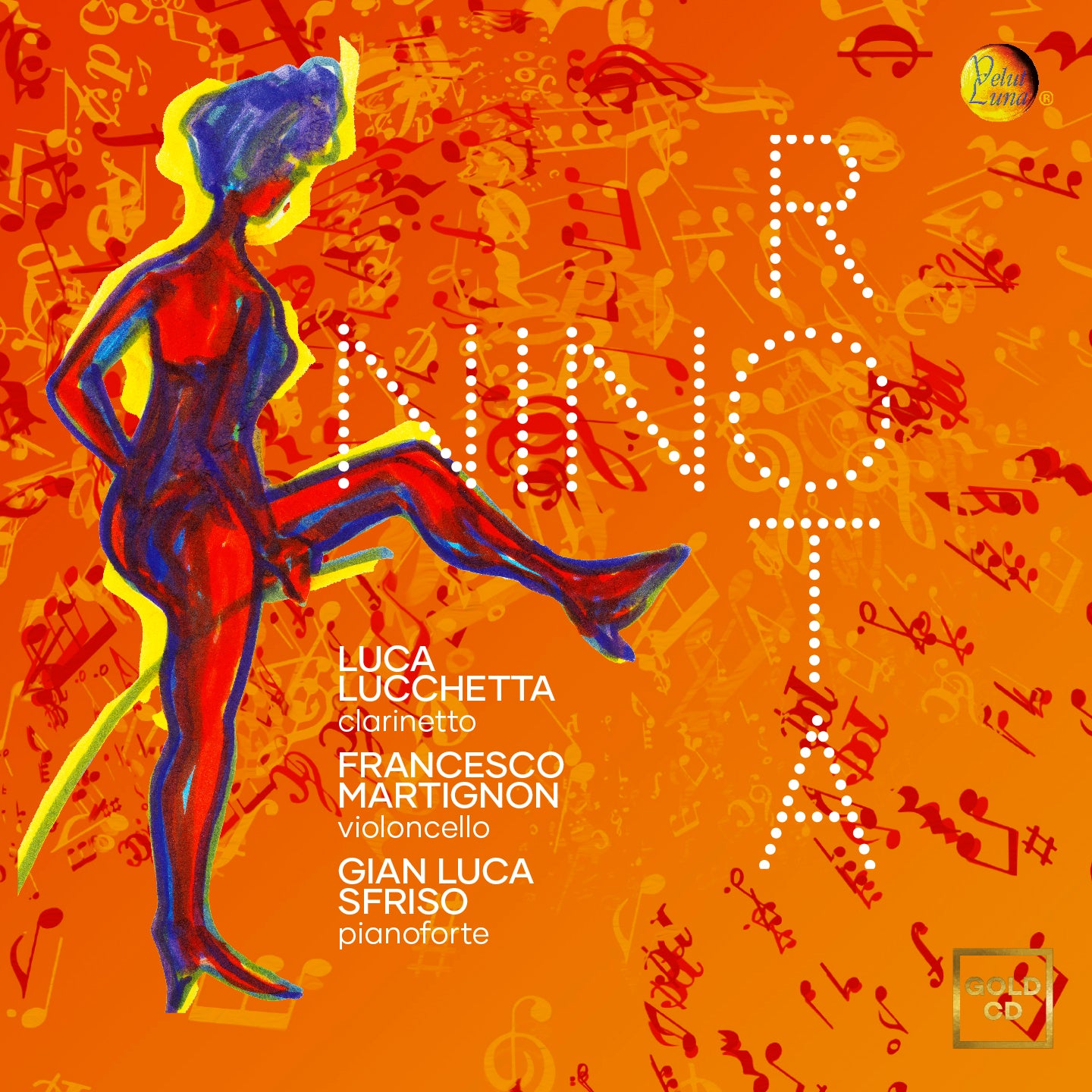
NINO ROTA - Lucchetta, Martignoni, Sfriso
NINO ROTA - Lucchetta, Martignoni, Sfriso
Music genre: Classica
In stock
Couldn't load pickup availability
NINO ROTA - Lucchetta, Martignoni, Sfriso (CVLD379)
Nino Rota (1911 - 1979)
Available in : HD File, Gold CD
Trio for clarinet, cello and piano (1973)
1 - Allegro 5:36
2 - Andante 4:25
3 - Allegrissimo 4:50
4 - Allegro danzante for clarinet and piano (1977) 3:22
Sonata in D for clarinet and piano (1945)
5 - Allegretto liscio 5:04
6 - Andante (almost adagio) 3:59
7 - Allegro liscio 4:34
Spiritism in the Old House for clarinet solo (manuscript copy) (1950)
8 - Six variations 7:11
9 - Three suggestions 4:17
total time: 43:26
88.2kHz / 24bit original digital recording made at Magister Recording Area, Preganziol (Italy),
on May 27, 28, 29, 2024 Analog mixing and mastering made at MLStudio, Naquera (Spain), on June 5, 2024
Production: MARCO LINCETTO for VELUT LUNA
Recording engineer: Andrea Valfrè, with Marco Lincetto
Mix and mastering engineer: Marco Lincetto
Cover and layout: L'Image
AD and Distribution: Reference Music Store
Among the four chamber music compositions brought together on this disc, as if to mark certain moments in the rich compositional journey, the one for solo clarinet dating back to 1950 offers a singular suggestion that leads us, as if through an enigmatic shortcut, to touch upon an aspect of the character: just for that title, “Spiritism in the Old House” – that of a comedy by Ugo Betti for which Rota had written the incidental music – which seems to suggest a particular air behind the more common, casual image, the one that Andrea Zanzotto had summarized as "a shining making", a sign of gratitude towards the musician thanks to whom he said he had rediscovered "like an elf, that timeless, gentle 'deus' that is inherent in the music itself"; with that soothing familiarity, too, that led the great poet to recognize that "with Rota's music one often feels like saying: but I've already heard this motif".
A satisfaction that doesn't dispel that slightly strange feeling one feels every time one listens to it, as if strange ghosts were lurking behind that naturalness; those that had enchanted Fellini while working with the musician: "Nino becomes an instrument, and one has the somewhat ridiculous illusion of composing the soundtrack, so much so that Nino fits in with total precision, so much so that he becomes the music needed at that moment..."
And it is precisely this naturalness that seems to be shrouded in a certain ambiguity, narrowing the composer's image to a pure, happy instinct, which was certainly Rota's innate and highly distinctive gift, but which actually implied an equally extraordinary awareness and ability to navigate the linguistic Babel of the twentieth century, as evidenced by the breadth of his output, which grew outside of his cinematic experience. He was, moreover, unaffected by genre or hierarchies, as he himself acknowledged: "I don't believe in class or level differences in music. In my opinion, the definitions of light, semi-light, and serious music are fictitious. Offenbach's scores, now approaching 150 years old, may be as light as you like, but with a lightness that endures over time and has a formidable vitality..."
Like one liberated by its own unmistakable language, clear, captivating, and yet with a hint of bitterness hidden within the folds of that exemplary clarity of writing. To speak of an unmistakability that is also indefinable for those who need cataloguing certainties, for what they count today, increasingly eroded, denied, confused.
On the twentieth anniversary of Rota's death, at a conference held by the Cini Foundation, which currently holds the composer's entire legacy, one of the themes that emerged was that of "candor" as a category within which to place the lyrical vocation of a musician like Rota, apparently so detached from so-called "modernity"; a theme which, far from being a tranquil escape to the Elysium, is in fact no less disturbing.
Fellini, who like few others closely touched Rota's enigmatic aura, spoke of a "sensitive" musician, later denouncing the carelessness that followed his death as "enchanted." Andrea Zanzotto, another keen observer, suggested that the term candor could imply its opposite, even "the ominous pallor of death," which is certainly not the case with Rota. Yet it serves as an element of alternation to create a play of perspective that is both alluring and subtly insidious, precisely because of the tone of his delivery, whose naturalness, the undoubted fruit of an unquestionable musical talent, is imbued with acute interferences, sometimes overt but also more subtle, which cannot fail to resonate problematically against a backdrop like that of the twentieth century and beyond, dominated by the "negative."
Is Rota's voice truly angelic and candid, we might naturally ask?
Gian Paolo Minardi
The clarinet for which Rota wrote "Spiritismo della vecchia casa" was a different instrument from those in use today. It had an elongated lower body and an additional key, which allowed it to extend its range by a semitone toward the low end. It was very popular in Italy at the time.
The modern edition of the composition was transposed for practical purposes, to allow the piece to be performed on instruments currently in use. However, this lost the depth of sound in the lower notes that Rota undoubtedly drew inspiration from to enhance the evocative quality of his composition. This recording, based on the manuscript preserved in the library of the Giorgio Cini Foundation in Venice (kindly made available for consultation) and featuring the notes actually written by Rota, was made possible thanks to the instrument provided by Buffet & Crampon of Paris, a BCXXI, which is equipped with the mechanism necessary to provide us with this precious testimony.
Luca Lucchetta
Tutto ottimo, qualità artistica e incisione (come sempre). Non sto a commentare i dettagli tecnico/audiofili perchè è tutto perfetto.
Opere di Nino Rota poi davvero rare da trovare, oltretutto con questa qualità di esecuzione e incisione
Share
-

Shipment of physical products
Free shipping in Europe (EU), from 4 items - Request quatozione for shipping costs for countries no EU
-
Digital product delivery
The delivery of digital products will take place directly on the site and you will also receive an email with the link to download the files.
-
Write a review
Above, you can write a review about the product you purchased, we will be happy to hear your opinion.
