
Velut Luna
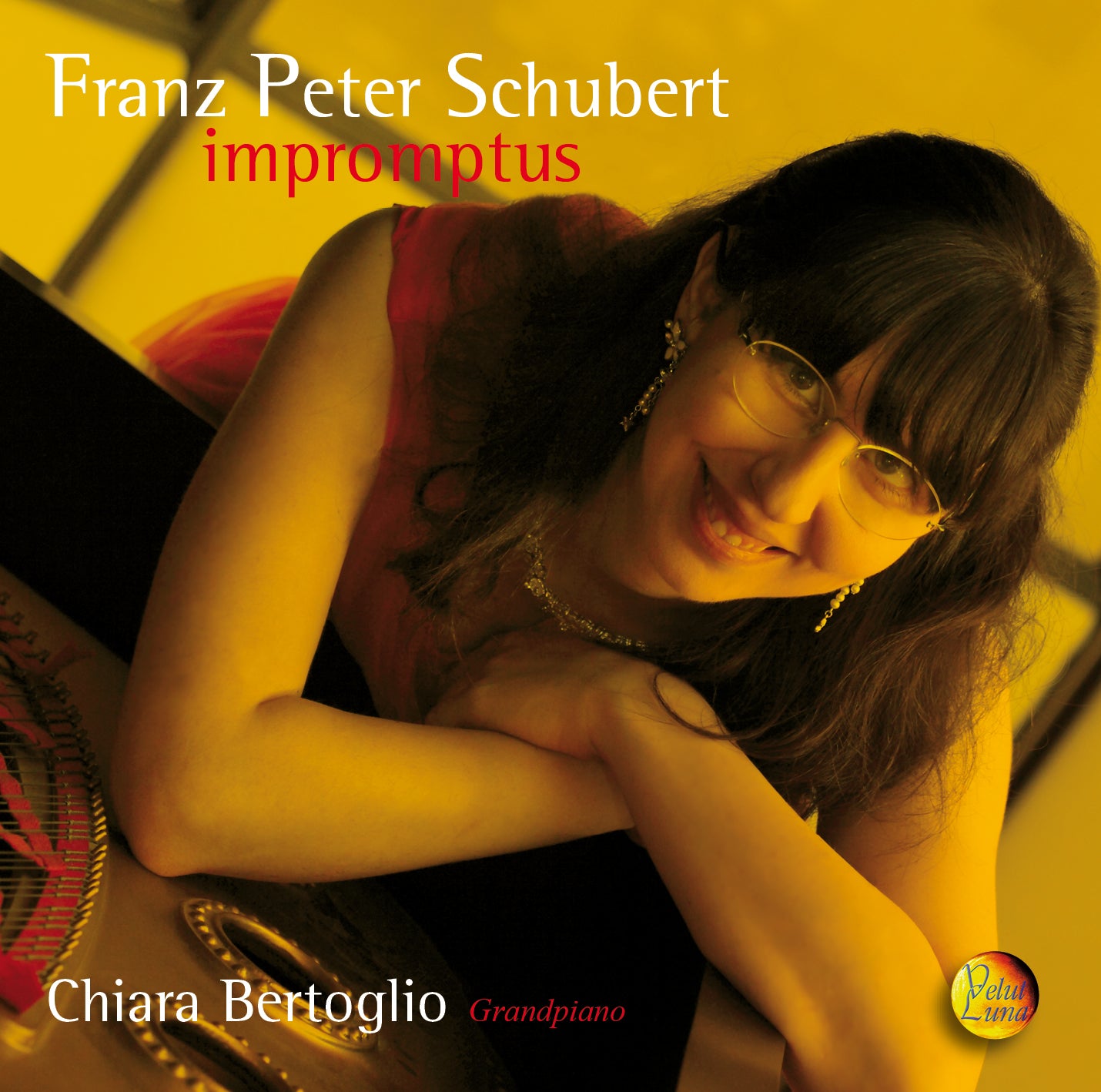
SCHUBERT: IMPROMPTUS - BERTOGLIO
SCHUBERT: IMPROMPTUS - BERTOGLIO
Music genre: Classica
In stock
Couldn't load pickup availability
SCHUBERT: IMPROMPTUS ( CVLD233 )
Author : FRANZ PETER SHUBERT
Performer : CHIARA BERTOGLIO
Available in: HD File, CD
Production: Velut Luna & Chiara Bertoglio
Executive & Recording Producer: Marco Lincetto
Recording, Mix & Mastering Engineer: Marco Lincetto
Editing: Mattia Zanatta
Photos: Marco Lincetto
Design: the image
Marketing: Francesco Pesavento
Sales Managers: Moreno Danieli & Patrizia Pagiaro
Press Agent: Emanuela Dalla Valle
World Wide Contacts: Cristiana Dalla Valle
Traces
01 - F. Schubert: Vier Impromptus op.90 D.899 - n.1 in C minor
02 - F. Schubert: Four Impromptus op.90 D.899 - No. 2 in E flat major
03 - F. Schubert: Four Impromptus op.90 D.899 - No. 3 in G flat major
04 - F. Schubert: Four Impromptus op.90 D.899 - No. 4 in A flat major
05 - F. Schubert / F. Liszt: Impromptu S.565b - No. 1 in E flat major
06 - F. Schubert / F. Liszt: Impromptu S.565b - n.2 in G major
07 - F. Schubert: Vier Impromptus op.posth.142 D.935 - n.1 in F minor
08 - F. Schubert: Vier Impromptus op.posth.142 D.935 - n.2 in A flat major
09 - F. Schubert: Vier Impromptus op.posth.142 D.935 - n.3 in B flat major
10 - F. Schubert: Vier Impromptus op.posth.142 D.935 - n.4 in F minor
Classical. Original compositions by Franz Peter Shubert. Chiara Bertoglio grand piano.
24bit/88.2 kHz original live-in-studio recorded, in Velut Luna Studio, Preganziol, Italy, on August 7- 2012.
Notes
Among Franz Schubert's piano works, the eight Impromptus, Op. 90 and Op. 142, are perhaps among the best-known and most frequently performed, and are certainly performed and listened to far more often than many of the enchanting Sonatas. It therefore seems pointless to reiterate here, in the inevitable brevity imposed by the size of a booklet, the analyses and studies that have been conducted on them; perhaps it is more useful to limit myself to offering the reader a "presentation" of these pieces, a guide that integrates with the key to understanding them that I propose with my interpretation.
I've had a very long relationship with the Improvvisi, some of whom have been around for over twenty years; and I can say they are true musical "friends," whose discreet and constant presence has shaped my journey as a musician and as a person.
Those of Op. 90 have more defined characteristics and clearer, more limpid structures. Schubert's extraordinary imagination and emotional richness are still channeled into "clean" forms, with the alternation and juxtaposition of different levels of compositional articulation. No. 1 plays entirely on the contrast between the martial rhythm of the incipit and the softness of a melody accompanied by a murmur of triplets. No. 2 is simple only in its macrostructure, which alternates sections of uninterrupted scales, almost waves of notes, with a Trio and a Coda of almost barbaric aggression; however, the dance rhythm that runs through it is the same in both sections, with the accent falling askew on the second beat of the measure.
No. 3 is justly celebrated, a sort of wordless Lied that would be reductive to define as a simple accompanied melody. The richness of its pervasive and omnipresent harmonic texture makes it much more akin to a polyphonic piece, in which the fluidity of the harmony allows its contrapuntal richness to emerge, veiled by the enchantment of melodic contemplation. No. 4 weaves together a series of garlands of arpeggios that alternate with the absorbed stasis of the chords and an ascending progression on the left hand's voice that admirably builds to the climax that concludes both the first part and the entire impromptu. Nestled between the final sections is a Trio of infinite beauty, almost a prayer in which, once again, the inner voices of the chorale are made vibrant by repetitions and repetitions.
Op. 142, on the other hand, is more compact, so much so that Schumann hypothesized a sonata-like conception of it (an approach I personally share), but on the other hand, more indecipherable. Each of its four Impromptus (which were renamed as such by the first editor) displays a kaleidoscope richer in emotion and more difficult to interpret than those of Op. 90.
No. 1, in particular, presents a highly complex series of unforgettable moments: the solemn and tragic opening, which inaugurates not only this piece but the entire series; the changing reverberations of a subject hidden among the tremolos; the “duet” in which the left hand responds to itself, continually overriding the circular and hypnotic movement of the right.
The stylistic signature of No. 2 is more homogeneous, unique in its reconciliation of choral, Lied, and dance forms: it is perhaps the mystical pinnacle of the Impromptus, with a serene, composed, and absorbed beauty. No. 3, composed of variations on a theme from Rosamunde, leads us on a journey that revisits, in miniature, all the great themes of Schubert's Romanticism: the circular rhythm of the first variation, the joy of life of the second, the hopeless darkness of the third, which opens to dance in the fourth and dissolves into a shower of scales in the last.
The cycle concludes with No. 4, rich in Hungarian folk movements, with a theme brimming with energy and vivacity, once again not without deliberate barbarism. And once again, Schubert demonstrates the melodic and narrative potential of scales, which here are presented in an almost obsessive manner and colored by the harmonies of the left hand, becoming a musical resource of unimaginable charm.
Completing the CD are Franz Liszt's versions of the Impromptus, Op. 90, Nos. 2 and 3. In Liszt's interpretation, No. 2 increases its virtuosic connotation (for example, with the addition of "filler" notes) and accentuates the "Hungarian" character of the Trio and Coda. Liszt instead transposes No. 3 into the more comfortable and – above all – less problematic, mysterious, and obscure key of G major (from the original in G flat); in the reprise of the main theme, Liszt offers a highly personal rewriting, reminiscent of the atmosphere of the celebrated Liebestraum.
Chiara Bertoglio
Share
-

Shipment of physical products
Free shipping in Europe (EU), from 4 items - Request quatozione for shipping costs for countries no EU
-
Digital product delivery
The delivery of digital products will take place directly on the site and you will also receive an email with the link to download the files.
-
Write a review
Above, you can write a review about the product you purchased, we will be happy to hear your opinion.
